Source note [1] Taylor Spears and Geoffrey Baker, “Generative AI for Financial Research,” Conference on the Economics of Financial Technology, University of Edinburgh Business School, June 21, 2023. Conference transcript and presentations supplied to the author.

In June 2023, ChatGPT had been publicly available for approximately six months. The phrase "retrieval-augmented generation" had not yet entered the business mainstream. A session at the University of Edinburgh's Conference on the Economics of Financial Technology, however, articulated much of what would come to dominate enterprise AI strategy over the subsequent three years. Looking back from October 2026, this article examines the experiment's architecture, which predictions held up, what subsequent AI advances addressed and which questions remain unresolved.
The session was deliberately unconventional. Taylor Spears, a PhD researcher who opened the discussion, stated that the presentation would involve no formal economic models or equations, and no formal academic talk. The objective was speculation about the trajectory of generative AI for finance researchers, practitioners, and regulators[1].
Joining him was Geoffrey Baker, CEO of InteliGems Labs, a conversation intelligence and speech technology company. His contribution was the application of AI to audio and video recordings of financial conferences for the extraction of structured intelligence at scale, using Versational, a product of InteliGems Labs[2].
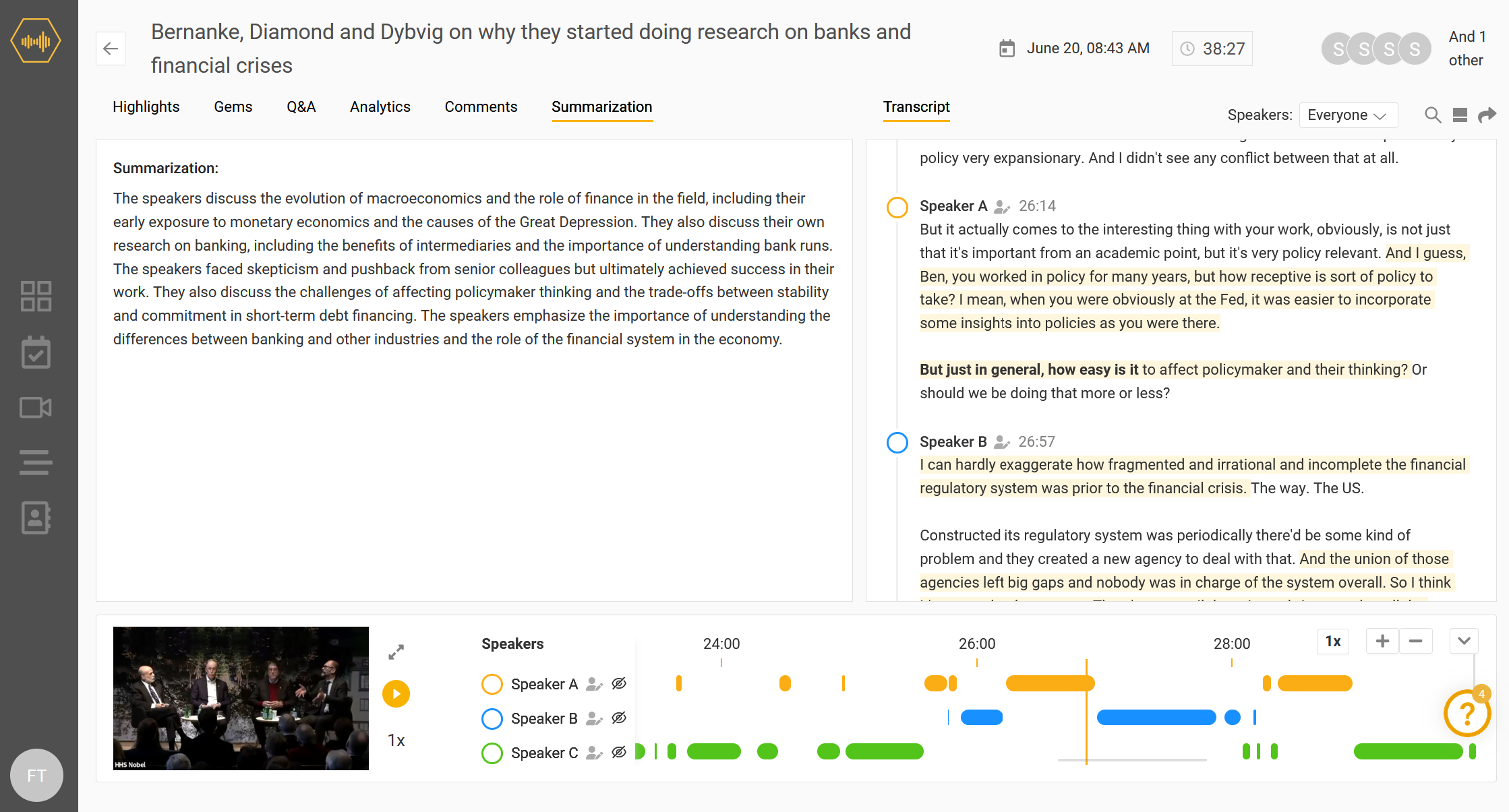
The team took 35 recordings from fintech, financial services, and banking conferences and uploaded them into the Versational platform. They scraped conference agendas to identify topics, used tools such as Bard and ChatGPT to construct keyword sets, and applied supervised topic models, natural language processing, and generative AI to extract structured intelligence from the conversations[2].
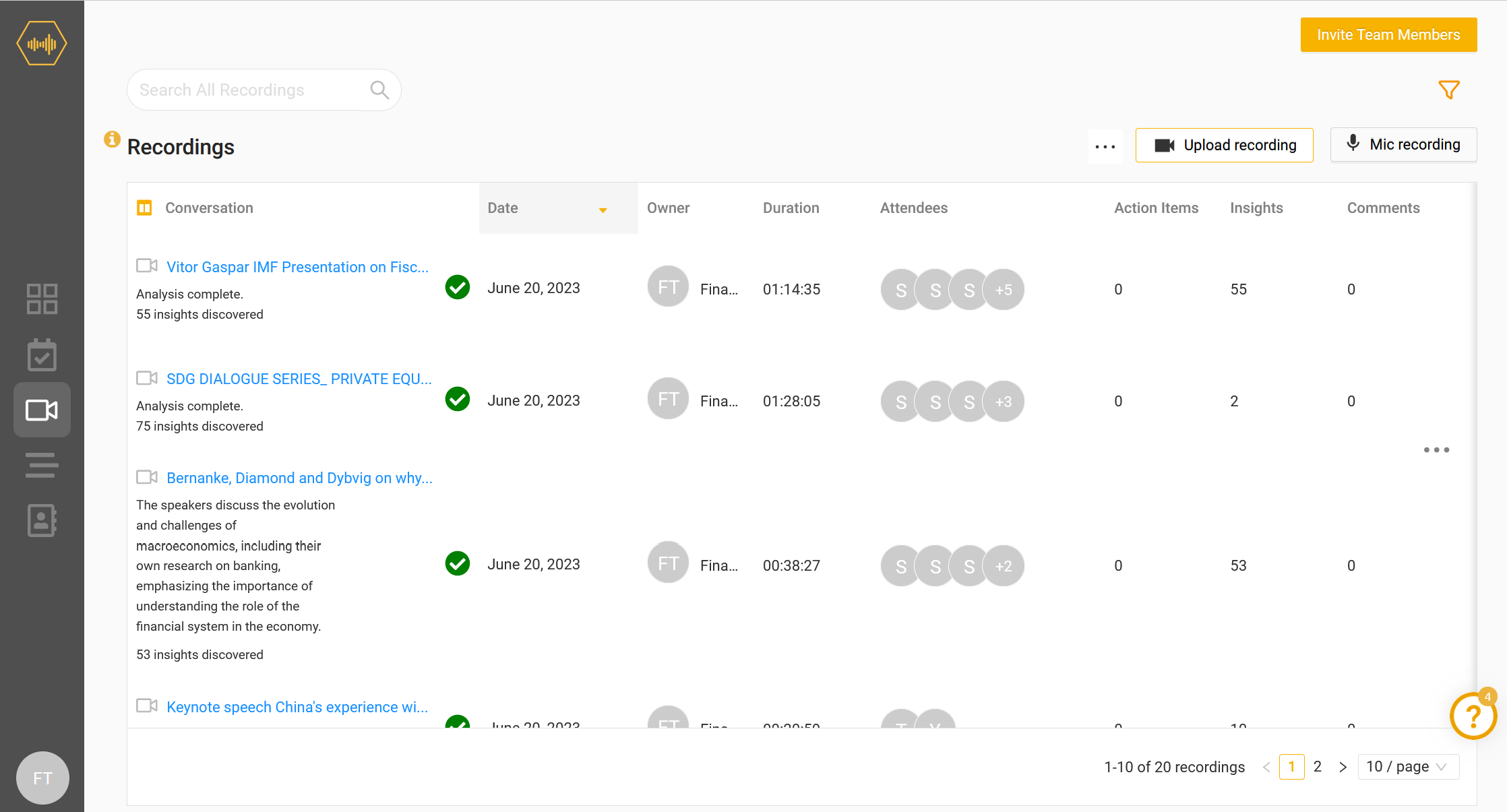
The pipeline operated in sequential layers: topic curation from scraped agendas, supervised topic modeling across the 35 sessions, insight extraction (needs, pain points, objections, and decisions, tagged by cohort and classified by speaker), contextual drill down linking each insight to the precise transcript moment, and finally a generative AI querying feature called "Ask AI Ally" that enabled users to pose questions to individual conversations or to the full collection simultaneously[2]. The entire process was completed in a single day. Baker was careful to emphasize, however, that human validation remained essential[2].
The distinguishing feature was evidence lineage: researchers could return from an extracted observation to the speaker and the underlying conversation. Processing the sample in a day was a reported experiment outcome, not proven analyst hours saved or enterprise ROI.
Sequential research workflow from the conference demonstration. Swipe horizontally on a narrow screen to view every step. See the conference source in endnote [2].
One of the session's most revealing moments was not a product demonstration but a founder describing the threat to his own business. ChatGPT had been released on November 30, 2022. By January 2023, Baker called its arrival a "black swan event" for InteliGems Labs[2]. The issue was immediate: how should a company respond when a new technology with broad capabilities challenges the economics and differentiation of capabilities it has already funded?
InteliGems Labs had invested substantially in supervised BERT models[4] and other specialist models tuned for particular conversation-analysis tasks. Baker's question was whether that R&D investment would become obsolete or whether models with broad capabilities could extend what the company had built[2]. From an operating perspective, the choices were to defend the existing approach, abandon it or adapt the product architecture before the market made the choice for them.
"How is that going to impact our business? Is it going to wipe out all the R&D money that we just spent on our supervised BERT models? How is this actually impacting us and will it actually start to replace components of what we do?"[2][4]
The team chose adaptation. Rather than discard its supervised topic models, it integrated large language models alongside them: specialist classification for defined tasks, generative AI for querying and synthesis[2]. The lesson is not that every legacy investment should be preserved. It is that technological disruption forces an explicit decision about which existing capabilities still create value, which should be replaced and where the new technology changes the product's economics. That dilemma faced by a founder and operator gives the 2023 demonstration relevance well beyond financial research.
Financial researchers do not simply need shorter transcripts. They need to find a claim across hours of discussion, identify who made it, recover the question or qualification around it and decide whether it is reliable enough to use. That was the more consequential ambition of the 35-session demonstration. It brought recorded conversation into a workflow for classification, research linked to its original sources and eventual action, rather than treating a meeting summary as the end product.
Baker briefly referred to the forgetting curve to explain why details can become harder to retrieve after a conversation. The memory research is an analogy, not a measurement of meeting recall[13]. The larger research problem is preserving enough context to revisit what people actually said.
Baker returned repeatedly to one concept: lineage. He argued that researchers required the ability to trace any insight generated by AI to the exact moment in a conversation where it was articulated, the question that prompted it, and the setting in which it arose[2]. Baker's emphasis on preserving the source of an extracted observation anticipated a requirement that would become central to enterprise retrieval systems: generated findings must remain connected to evidence that users can inspect. Although retrieval-augmented generation, or RAG, had already been described in 2020 research[12], the Edinburgh discussion illustrated how retrieval, specialist classification, and generative models could be combined in practical financial research workflows. Audio and video content is transcribed to text, converted into vector embeddings for similarity search, and when a user poses a question, the system retrieves the most relevant transcript segments and supplies them as context to a language model. This distinction, between the embeddings used to locate content and the actual text supplied to the model, is what enables source lineage. Baker's insistence on this traceability anticipated the governance requirements that made RAG an increasingly important architecture for enterprise AI by 2025.
In the final technical exchange of the session, an audience member inquired how a company with a small proprietary dataset could leverage a powerful language model without training a new foundation model. Sanjay Rakshit, CTO, InteliGems Labs, explained the retrieval approach: create embeddings from the company's information, identify relevant material in a vector database, and provide that context to an existing language model[2]. Since then, the retrieval landscape has advanced considerably. Corrective RAG (CRAG), published in January 2024, introduced a lightweight retrieval evaluator that assesses retrieved document quality and triggers corrective actions including web search fallback[10]. GraphRAG, developed by Microsoft Research and published in February 2024, employs LLM generated knowledge graphs to address questions requiring relationships and themes across an entire information collection[9]. None of these techniques provides an automatic guarantee of factual accuracy. They reinforce the principle Baker articulated in 2023: what the model knows, what the system retrieves, and what the user can verify are distinct things.
Baker also described how extracted insights could be transferred directly into workflow systems: action items into Jira, sales data into CRM systems, decisions into project management platforms[2]. By 2026, this conversation to action pipeline has become a recognized product category, with enterprise platforms competing on the depth of their workflow integrations. The ambition to turn conversations into institutional knowledge also raises governance questions that the session did not fully address: whether every recorded conversation should be made searchable, classified, and actionable, and what consent, confidentiality, retention, and access controls should govern persistent records of discussions.
Taylor Spears also warned that making information easy to classify can remove the context necessary to understand it. An accurate taxonomy is not the same as an accurate interpretation.
Source lineage solves only part of the research problem. An answer may correctly cite a transcript while misinterpreting the discussion. The distinction Spears raised is particularly important: making complex information searchable and classifiable does not necessarily preserve its meaning. A system might correctly identify the speaker, transcript passage, and classified topic while missing sarcasm, disagreement, qualifications, or the surrounding argument. Reliable AI research requires both evidence that can be traced and interpretations that can be challenged.
The strategic landscape Baker and Spears described in 2023 has shifted substantially. The table below summarizes the principal dimensions of change between June 2023 and October 2026.
| Dimension | June 2023 | Q4 2026 |
|---|---|---|
| Meeting intelligence | Transcripts, topic models and specialist speech pipelines. | Meeting summaries are widespread; traceable knowledge across sessions remains differentiated. |
| Retrieval and context | Vector search and retrieved context enabled work with proprietary data. | Reranking, Corrective RAG and GraphRAG address weaknesses in simple retrieval. |
| Model capabilities | Summarization, extraction and question answering predominated. | Multimodal models and tool-using agents undertake complex, multistep tasks. |
| Validation | Hallucination, labels and prompt sensitivity were recognized concerns. | More systematic evaluation is possible, but citations and fluency do not establish correctness. |
| Systemic risk | Shared models, data and infrastructure posed anticipated risks. | Regulators explicitly examine third-party concentration, model risk and correlations. |
Stanford's 2026 AI Index reports that 88% of surveyed organizations used AI in at least one business function during 2025[5]. However, agent deployment remained in the single digits across most business functions[5]. Adoption should therefore not be conflated with mature, accountable autonomy. The transformation is real but uneven.
Spears framed the discussion around anthropologist James C. Scott's idea of legibility: the ability of powerful institutions to make a complex world easier to classify and govern. Scott warned that simplified representations can miss local knowledge, or metis[3]. Spears asked whether generative AI and the platforms behind it could impose comparable simplifications on financial information[3].
This is the distinction between finding the right source and understanding what it means. A system might retrieve the correct passage from a banking discussion and tag it as an observation about regulatory risk yet miss that the speaker was disputing the claim, qualifying an assumption or describing a hypothetical scenario. This is an illustration, not a reported failure of the 2023 system. Source lineage lets a researcher check the evidence; it does not establish that an interpretation generated by AI is faithful. Spears' concern therefore extends beyond retrieval accuracy to human review and the decisions made from evidence.
Model economics also changed. Stanford's AI Index reported that the cost of GPT-3.5-level inference fell more than 280-fold between late 2022 and late 2024[6]. By 2026, enterprises had a wider choice of models and deployment approaches. The strategic question increasingly became which architecture delivered reliable results at an acceptable total operating cost.
Spears warned in 2023 about systemic risk arising from infrastructure concentration and dependence on common suppliers. Drawing on work by SEC Chair Gary Gensler, he argued that generative AI could create new forms of systemic risk, not from the technology itself but from how it might be integrated into financial infrastructure[3]. He drew an analogy to common trading and portfolio-insurance strategies around the 1987 crash as a historical parallel: when every institution employs the same model, a stress event can amplify rather than absorb shocks[3].
By 2024, survey evidence was emerging that supported concerns about supplier concentration. The Bank of England and FCA published their third AI survey of UK financial services in November 2024[7]:
AI use cases involving third-party implementations, up from 17% in 2022.
Share of reported cloud providers represented by the three most named providers.
Share of reported model providers represented by the top three, up from 18% in 2022.
Source: Bank of England and FCA, Artificial intelligence in UK financial services – 2024. These are shares of reported providers or use cases, not global market shares. [7]
The concentration in model providers is particularly notable. The top three accounted for 44% of named providers in 2024, an increase from 18% in 2022. These figures are shares of reported providers, not global market shares. The same survey also found that 55% of reported AI use cases involved some automated decision-making, while only 2% were fully autonomous[7]. This gap between automation and autonomy is directly relevant to the Edinburgh discussion: AI capability and the responsible delegation of decision authority are moving at different speeds. The Financial Stability Board reinforced these concerns in its November 2024 and October 2025 reports, identifying third-party dependencies, service provider concentration, and market correlation risk as key systemic vulnerabilities[8].
These findings do not establish that AI has caused systemic instability. They do demonstrate why Spears' 2023 concern deserves attention: as AI becomes more deeply embedded in financial operations, institutions must consider dependencies and correlated risks beyond the performance of their individual models.
The question and answer session revealed the tensions that researchers and practitioners confront most acutely. Three years later, those tensions remain largely unresolved. The audience questions, recorded in the full conference transcript, retain considerable relevance. The questions below come from the longer session transcript, not the shorter embedded Vimeo video[1].
An attendee asked whether a system could account for micro expressions, speaker history, and nonverbal cues. Baker discussed exploratory work involving pauses, vocal pitch, timing, and prosody, distinguishing this from facial recognition, which the team was not pursuing[2].
What changed by 2026? Multimodal models process speech, images, and video more capably, but analyzing vocal characteristics should not be conflated with reliable detection of deception or emotional states. Richer inputs provide more context but introduce new privacy, bias, and interpretation risks.
An audience member described asking generative AI for a literature review and receiving references to papers that did not exist[1]. Spears offered a durable framework: generative AI is best suited for problems where finding a solution is substantially more costly than verifying it[1].
What changed by 2026? Evaluation tools and retrieval methods have improved, but a confident sounding answer or citation is not equivalent to independent verification. The key question is whether the workflow can verify outputs at a cost proportionate to the benefit and risk.
Baker reported that InteliGems Labs benchmarks action-item extraction accuracy at approximately 84% on the fifth model release[2]. This is an internal, task-specific benchmark, not a general accuracy measure. Baker acknowledged that the industry's validation processes are "not very rigorous in general" and that the figure requires independent academic validation[2].
What changed by 2026? Model evaluation has become a distinct discipline. General benchmarks, however, cannot replace a validation dataset reflecting the organization's own tasks and operating risks. A financial research system should be evaluated on whether it preserves underlying meaning, not merely whether the prose is convincing.
An attendee raised whether creators of training data retain incentives to publish if model developers can use it without compensation. Spears cited the GitHub Copilot controversy as a legal gray area[1]. Baker anticipated increased interest in greater use of private, controlled enterprise data environments, a direction visible by 2026[2].
What changed by 2026? Data permissions, intellectual property, and information governance have become central to AI procurement. Private retrieval and private training are not equivalent. The important design question is who can access which information, for what purpose, and under what controls.
Sanjay Rakshit, CTO, InteliGems Labs, explained two approaches: retrieval-augmented generation using embeddings, and fine tuning on the domain-specific corpus. For very small datasets, retrieval based approaches are more practical than training from scratch[2].
What changed by 2026? This has become a mainstream pattern. The problem is no longer simply retrieving the nearest document. Modern systems must account for permissions, conflicting sources, relevance, freshness, and whether the model should decline to answer when evidence is insufficient.
By October 2026, leading models and agent platforms can execute longer multistep tasks, navigating software, using tools, and preparing actions for execution. This increases potential value but alters the risk profile: an agent acting on incorrect information can modify a system, update a record, or propagate an error across connected applications. The distinction is between three levels of responsibility[1]: information assistance, where the system retrieves or summarizes for a human who decides; decision support, where the system recommends an action that a human retains authority to approve or reject; and delegated execution, where the system performs approved actions within defined permissions. These are not interchangeable operating models, and the NIST Generative AI Risk Management Profile (NIST AI 600-1, July 2024) provides a cross-sectoral framework for governing them[11].
The University of Edinburgh financial economics conference discussion leads to several practical questions for an organization considering AI investment[1]: What operating decision improves, and who is accountable? What evidence does the system use, and what are its permissions, freshness, and lineage limits? How will correctness be established against representative tasks rather than vendor benchmarks? Where does human judgment remain necessary? What authority can the system exercise, and under what controls? Does the economics justify the mandate after accounting for verification, supervision, and operating costs?
Three threads make the Edinburgh financial session worth revisiting: a founder deciding how to adapt when a breakthrough threatened his product, a demonstration that made recorded financial discussions searchable and traceable, and a researcher asking what classification might conceal as well as reveal. Advances in retrieval and AI agents have sharpened all three questions. Yet the experiment did not establish enterprise ROI or eliminate the need for expert interpretation. For an executive buyer, the test is not how impressively AI summarizes 35 recordings. It is whether the resulting evidence can be verified, the interpretation challenged, the next action authorized and the business value measured.
[1] Conference presentation and discussion. Taylor Spears and Geoffrey Baker, “Generative AI for Financial Research,” Conference on the Economics of Financial Technology, University of Edinburgh Business School, June 21, 2023. Full conference transcript and presentation materials supplied to the author; the shorter recording excerpt does not contain the entire audience Q&A.
[2] InteliGems Labs demonstration and practitioner remarks. Geoffrey Baker and Sanjay Rakshit, conference presentation and transcript, University of Edinburgh, June 2023; Versational product screenshots reproduced as historical evidence of the experiment. Reported performance and workflow outcomes are historical presenter statements, not independently validated enterprise ROI.
[3] Context, legibility and systemic risk. Taylor Spears, University of Edinburgh session and Q&A (June 2023), discussing James C. Scott, Seeing Like a State (Yale University Press, 1998), and Gary Gensler's warnings about correlated AI use in financial markets. The conference transcript is the source for Spears' interpretation.
[4] BERT (Bidirectional Encoder Representations from Transformers). Introduced by Google researchers in 2018, BERT is a language model that interprets words using both preceding and following context to represent meaning, nuance and intent. It supports search relevance, text classification and task-specific fine-tuning. Unlike generative language models, standard BERT is designed primarily to represent and classify text rather than compose free-form responses. Jacob Devlin et al., BERT: Pre-training of Deep Bidirectional Transformers for Language Understanding (2018; NAACL 2019).
[5] Enterprise AI adoption. Stanford Institute for Human-Centered Artificial Intelligence, 2026 AI Index Report: Economy. The 88% figure refers to surveyed organizations using AI in at least one business function during 2025; agent deployment remained early.
[6] Inference economics. Stanford HAI, 2025 AI Index Report: Research and Development. Reports an over 280-fold cost decline for GPT-3.5-level inference between November 2022 and October 2024.
[7] UK financial-services AI survey. Bank of England and Financial Conduct Authority, Artificial intelligence in UK financial services – 2024, November 21, 2024. Survey findings include third-party implementations and concentration in reported cloud and model providers.
[8] Financial stability and AI. Financial Stability Board, The Financial Stability Implications of Artificial Intelligence (2024) and Monitoring Adoption of Artificial Intelligence and Related Vulnerabilities in the Financial Sector (2025).
[9] GraphRAG. Darren Edge et al., From Local to Global: A Graph RAG Approach to Query-Focused Summarization, Microsoft Research, 2024.
[10] Corrective retrieval. Shi-Qi Yan et al., Corrective Retrieval Augmented Generation, January 2024.
[11] Governing generative AI. National Institute of Standards and Technology, AI Risk Management Framework: Generative AI Profile (AI 600-1), July 2024.
[12] Original RAG research. Patrick Lewis et al., Retrieval-Augmented Generation for Knowledge-Intensive NLP Tasks, 2020.
[13] Forgetting curve. Hermann Ebbinghaus, Memory: A Contribution to Experimental Psychology (1885); Jaap M. J. Murre and Joeri Dros, Replication and Analysis of Ebbinghaus’ Forgetting Curve, PLOS ONE 10(7), 2015, DOI 10.1371/journal.pone.0120644. Savings scores refer to relearning syllable lists, not meeting recall. The article's SVG connects selected data points in an illustrative design; it is not the fitted curve from the underlying research.
Strategy & Value

October 14, 2026
A sales playbook is a guide that helps sales teams close more deals and increase win rates.

October 14, 2026
A successful sales strategy prioritizes providing customer value and building trust over focusing on price alone.

Principal-led advisory and operating leadership for executive teams facing consequential AI, governance, transformation, commercialization, and recovery mandates.
advisory@inteligems.io